
About Us
What is Narrative Medicine?
Medicine unfolds through stories. Patients describe what hurts, caregivers recount what they have witnessed, clinicians interpret what they hear, and individuals make sense of experiences that may be difficult to express in clinical language alone. Narrative medicine asks us to pay closer attention to those stories.
Narrative medicine is an interdisciplinary field that draws on literature, writing, the arts, and reflective practice to better understand these human experiences of health, illness, caregiving, and medicine. At its core is narrative competence: the ability to recognize, interpret, and respond thoughtfully to the stories of others. Narrative can help patients give shape to experiences of illness, help clinicians listen beyond symptoms and accompany patients through uncertainty, and help caregivers, students, and healthcare professionals reflect on how encounters with illness and care shape them as well.
Physician and literary scholar Dr. Rita Charon formally articulated narrative medicine in 2001 as a model for more humane and effective medical practice. Since then, the field has expanded across healthcare, education, scholarship, and the arts, using narrative as a way to foster attention, reflection, empathy, and deeper understanding among the many people whose lives intersect with health and medicine.
For further reading on narrative medicine:
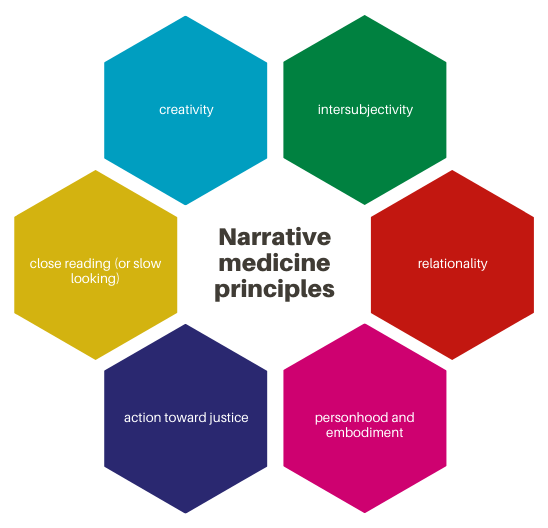
Narrative Medicine Principles (Czerska 2021)
In Practice
Narrative medicine is not simply writing down what happened to you. Its practice begins with attention and reflection, asking us to notice more carefully: what was said, what was not said, whose perspective we are seeing, what assumptions we brought to an encounter, and how our understanding changes when we revisit it.
Narrative medicine is often associated with creative nonfiction or personal essays about encounters with patients, but it extends far beyond that.
Fiction can imagine experiences and perspectives that allow writers and readers to explore illness, caregiving, uncertainty, disability, or relationships in healthcare.
Poetry can give form to experiences that may resist straightforward explanation.
Photography and visual art can direct attention toward details, bodies, spaces, absences, and perspectives that words may not fully capture.
Personal narratives and field notes allow writers to return to lived experiences and ask not only What happened? But, also Why has this stayed with me? What did I fail to notice at the time? What did I learn? What remains unresolved?
Is there an encounter that has stayed with you? An assumption you were not aware of before? A moment of learning changed the way I understand illness, care, another person, or myself? It does not need to be dramatic. A meaningful piece might emerge from a single sentence, gesture, silence, mistake, waiting room, ambulance ride, conversation, or observation. One of the best ways to understand the field is to read work already being produced within it.
- For example, check out: Narrative Medicine | JAMA Network
Patient Privacy Notice (HIPAA)
Writing about healthcare carries particular ethical responsibilities because the experiences that inspire us may also belong to someone else.
Before writing about a patient, family member, or another identifiable person, consider whose story you are telling and whether it is yours to share. Changing a name alone may not make someone unidentifiable; unusual diagnoses, locations, dates, occupations, family circumstances, or combinations of details can reveal identity.
Writers should familiarize themselves with patient-confidentiality principles, including HIPAA guidance on identifiable health information, and remove or alter information that could reasonably identify an individual. When appropriate, obtaining permission from the person represented may also be necessary.
Privacy is only one consideration. Ethical narrative medicine also asks writers to consider dignity, power, perspective, and representation. A technically de-identified story can still portray another person unfairly or claim knowledge of thoughts and experiences the writer could not actually know.
When in doubt, write more about your own response, uncertainty, observation, or change than about details of another person's life.
For further reading on narrative medicine:
How can you get involved?
In addition to submitting your work to literary journals like Impressions, explore the field of narrative medicine through coursework, workshops, events, and graduate study. Explore the list below for future opportunities:
- Pursue graduate or professional studies:
- Join or volunteer with narrative medicine-focused programs:
- Read and contribute to storytelling spaces:
- Look for narrative medicine or medical humanities courses, organizations, and events at your university. For example,
- the Narrative Medicine StudioLab, Public Programming: Narrative Medicine Rounds at Columbia University
- Medical Humanities Council at the Perelman School of Medicine